Your Top 25 Shows What's Working. What About the Products It Leaves Out?
Here's how to find the campaign products that don't have enough reviews yet, and get them review-ready for BFCM.
Black Friday lands on November 27 this year. By now, most merchants have picked the products they will discount, advertise and email about. Far fewer have checked whether those products have the reviews to back them up.
That gap is easy to miss. Your best-reviewed products are usually the ones you already know about. The risk is in the products you are about to push, like a new arrival or a holiday bundle you are putting ad budget behind. If a shopper clicks a BFCM ad and lands on a page with zero reviews, your discount has to persuade them on its own.
This guide shows how to find those products and get them review-ready in the three weeks before Black Friday.
Why your first five reviews matter more than your next 500
The biggest jump in shopper confidence happens between zero reviews and a handful. After that, each new review adds less.
The most cited research on this comes from Northwestern University's Spiegel Research Center, working with PowerReviews. The team studied data from three online retailers and found that a product with five reviews was about 270% more likely to be purchased than a product with none. Nearly all of the gain came from the first 10 reviews, and the first five did most of the work. Higher-priced items needed at least five reviews to see the full effect, while lower-priced items saw a meaningful lift with just two to four.
The study has limits. It was published in 2017 and covered only three retailers, one of them selling higher-priced gifts, so your store will not see the same numbers. Newer data points the same way, though. A 2023 PowerReviews survey found that 45% of shoppers say they won't buy a product with zero reviews.
For BFCM, that means coverage matters more than volume. Getting 10 campaign products from zero to five reviews will likely do more than adding 200 reviews to a product that already has 300.
Price raises the bar. The more a product costs, the more shoppers rely on reviews before they buy, and a discounted premium item still feels like a big purchase. New traffic raises it too. Many BFCM shoppers find you through ads and have never bought from you, so they have no reason to trust your store yet and lean on reviews more than usual.
The same study found that purchase likelihood peaks for products rated between 4.0 and 4.7 stars and drops as ratings approach a perfect 5.0. Shoppers expect some mixed feedback, so a few honest three- or four-star reviews can make the rest look more believable.
Find the gap: compare your BFCM list with your review data
The fastest way to find under-reviewed campaign products is to put two lists side by side: what you plan to promote, and what your reviews already support.
Step 1: Write down your BFCM product list. Include every product that will appear in an ad, a promotional email, your homepage banner or a dedicated sale page. Most stores end up with 10 to 30 products.
Step 2: Pull your review data. If you use LAI Product Reviews, open Shopify Sidekick from inside the LAI app and ask for Product Insights. For example:
"Which products should I consider promoting for BFCM based on customer ratings, review volume, and photo/video reviews?"
Sidekick returns up to 25 of your products, ranked by review count, with each product's average rating and number of photo and video reviews. The Sidekick guide lists other questions you can ask.
Step 3: Sort each campaign product into one of three groups.
Ready
On your top list, with several photo or video reviews. Feature its best reviews in ads and emails.
Thin
Has some reviews, but fewer than five or no photos. Prioritize review requests now.
Missing
Not on your top list, with few or zero reviews. Decide whether to collect reviews fast or swap it out of the campaign.
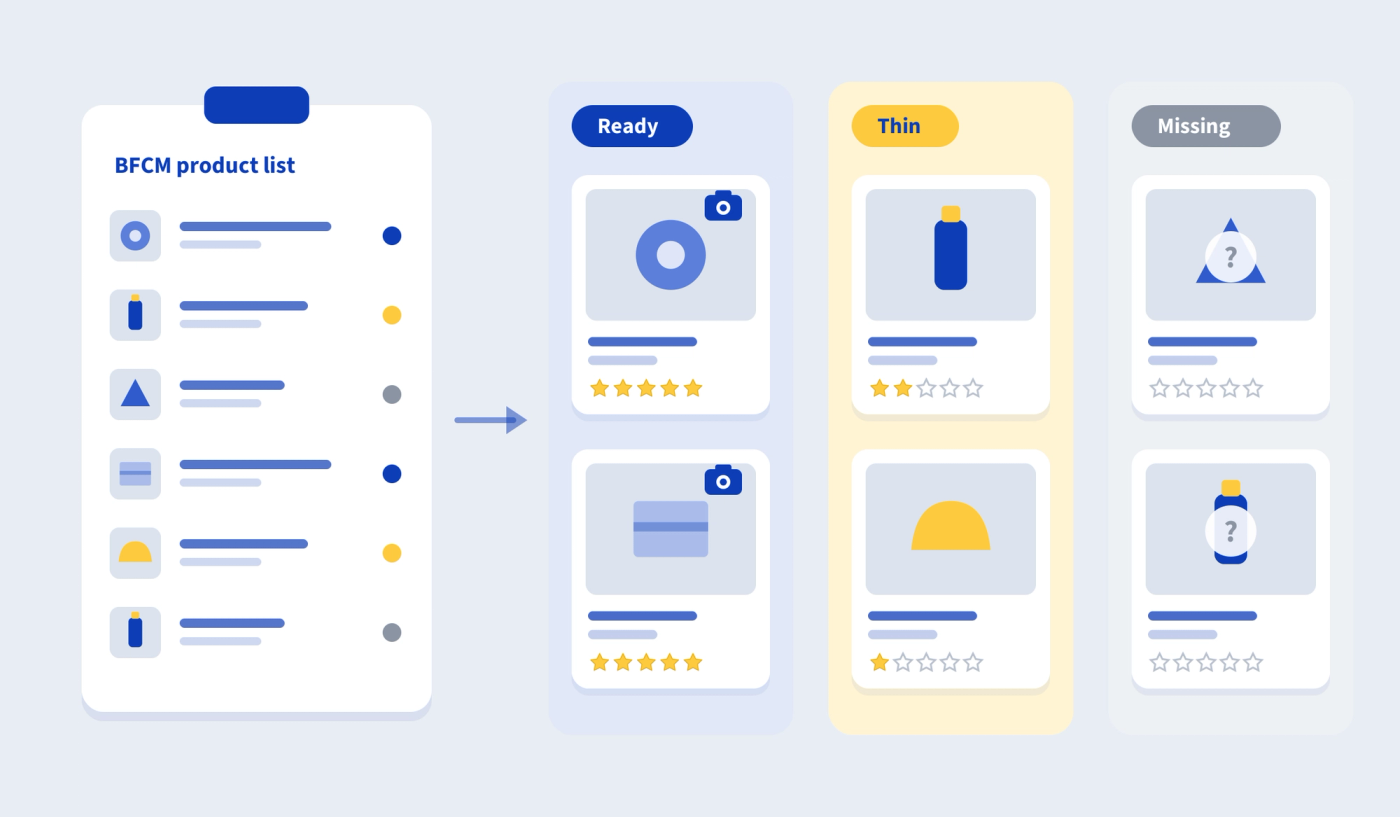
The third group is the easiest to overlook. A product missing from your top 25 is not automatically a problem; your catalog may simply be large. But if it is a product you plan to spend money promoting, it deserves a closer look.
It is also worth questioning the "Ready" group. Your most-reviewed products are often your bestsellers already. Heavy discounts on them can cut into margin on orders you would have won anyway. Sometimes the smarter BFCM pick is a well-reviewed product that simply hasn't had much visibility yet. Your review data gives you the evidence; the commercial decision is still yours.
The 3-week review sprint
Three weeks is enough time to move your "Thin" and "Missing" products forward, but only if you start with customers who already have their orders. A review request sent before delivery is usually wasted.
Week 1 (Nov 6 to 12): Ask past buyers. Your best source of fast reviews is customers who bought a campaign product in the last 30 to 60 days. They have used it, and they have not been asked yet. Send them a short, specific request. The Spiegel research found that about 80% of reviews come from follow-up emails, so email is where most of your new reviews will come from.
Week 2 (Nov 13 to 19): Automate and follow up. Turn on review requests timed to delivery, not to order date. In LAI Product Reviews, delivery-based emails handle this automatically. Then send one reminder to Week 1 customers who didn't respond. One reminder is usually enough; more starts to feel like pressure.
Week 3 (Nov 20 to 26): Display and fix. Stop focusing on collecting and start focusing on showing. Pin your strongest reviews, add photo reviews to product pages and check every campaign product page on mobile.
Ask for photos and videos directly, and tell customers exactly what to show. Shoppers trust real customer photos more than product shots.
Keep incentives honest. You can offer a discount for leaving a review, but you cannot make it depend on the review being positive. The FTC's Consumer Reviews Rule bans incentives tied to a specific sentiment, along with fake reviews and hiding negative ones. In December 2025, the FTC sent its first warning letters under the rule.
If you sell the same product on another marketplace or source it from a supplier, imported reviews can help fill the gap. Import reviews only for the exact same product, and never present them as something they are not.
What to ask for depends on what you sell:
Beauty and skincare
Shoppers want to see texture, results and skin type. Ask customers to share a photo after a few weeks of use and mention their skin type.
Fashion and activewear
Shoppers want to see fit, sizing and fabric. Ask customers to mention their usual size and height, and share a photo wearing it.
Home and living
Shoppers want to see the size in a real room and the build quality. Ask customers to share a photo of the product in their space.
Gadgets and accessories
Shoppers want to see setup, durability and compatibility. Ask customers to mention which device they use it with and how long they have had it.
Specific prompts lead to specific reviews. A review that says "I'm 5'4", usually a medium, and the medium fit perfectly" will sell more leggings than "Love it!" ever will.
Put reviews where BFCM shoppers decide
Collecting reviews only helps if shoppers see them at the moment they are deciding. During BFCM, that moment is short, and it usually happens on a phone. Mobile made up an estimated 54% to 57% of online BFCM sales in 2025, yet mobile conversion rates were roughly half of desktop's, according to statistics compiled by Ringly. Small screens leave little room to build trust, so every review placement has to earn its spot.
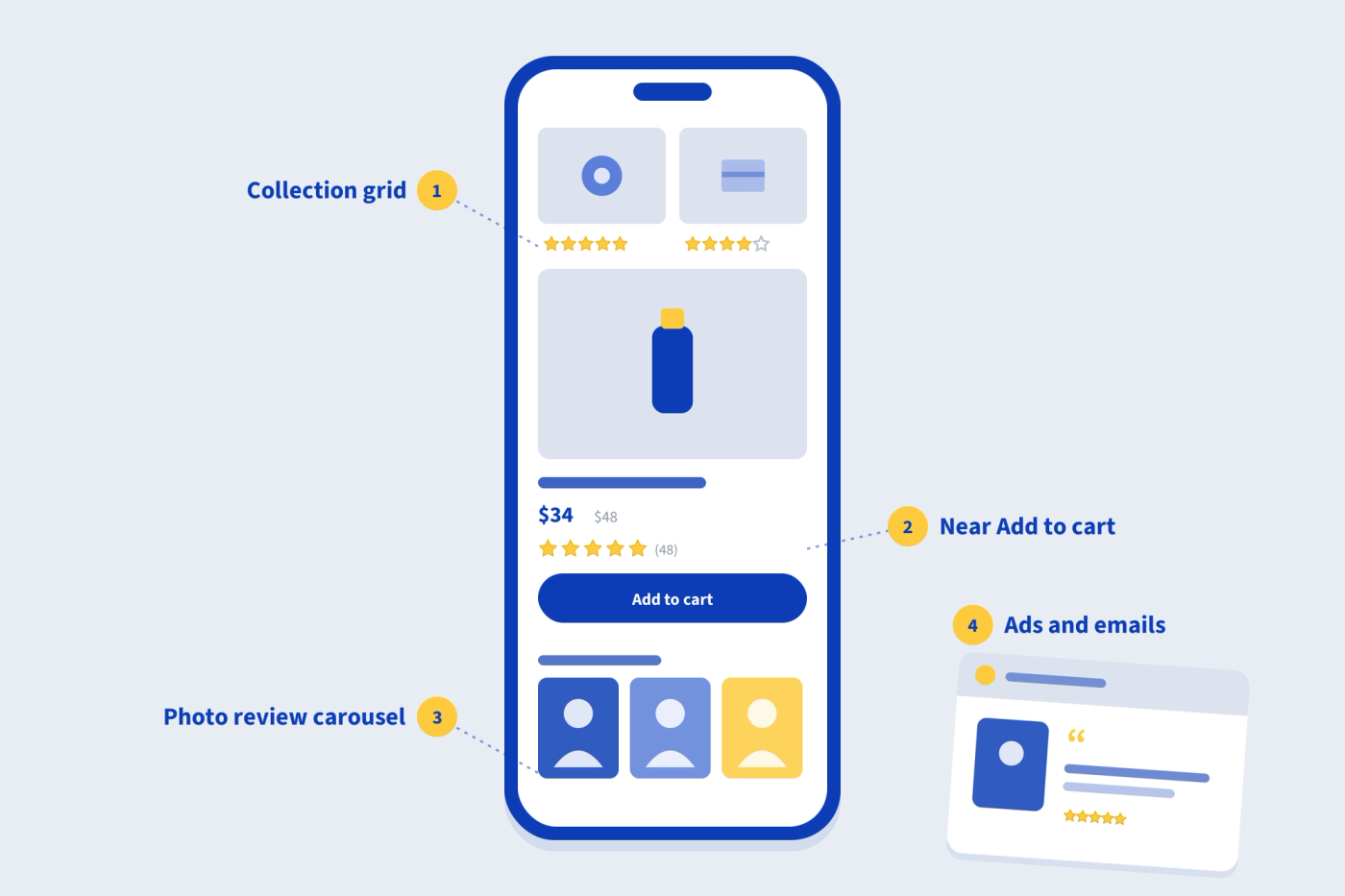
Focus on four places:
- Collection and sale pages. Show star ratings under each product. Shoppers scanning a grid of discounts use stars to decide what to tap.
- Near the Add to Cart button. Place the star rating and review count close to the price, where shoppers make the final call. A photo review here does more than a paragraph further down.
- Your homepage or BFCM landing page. A short carousel of photo reviews from your campaign products works well above or just below your main offer.
- Ads and emails. Use short quotes and customer photos from your "Ready" products. Real customer content often feels more convincing than polished brand shots.
Keep it light. Pop-ups, multiple widgets and heavy video can slow your pages at the moment speed matters most. Test every campaign page on a phone before November 27.
And don't stop on Cyber Monday. Carriers slowed down by 9% to 37% during last year's BFCM, so many reviews from holiday orders will arrive in December. Keep delivery-based requests running; those reviews will support your holiday gift sales.
Your pre-Black Friday checklist
- ☐ List every product you will promote for BFCM
- ☐ Pull your top products with Sidekick Product Insights and sort campaign products into Ready, Thin and Missing
- ☐ Email past buyers of Thin and Missing products this week
- ☐ Turn on delivery-based review requests and ask for photos
- ☐ Check that incentives never depend on a positive review
- ☐ Pin your best reviews and add photo reviews to campaign pages
- ☐ Test every campaign product page on mobile
Sources
- BFCM 2025 mobile and shipping figures, via Ringly
Want to collect reviews for your store?
LAI Product Reviews helps Shopify merchants collect, display and grow social proof.
Start now